Air-disc brakes are the clear direction of travel on heavy vehicles, and for a parts distributor that is not just an engineering story, it is a stocking one. As new trucks and trailers arrive with air-disc systems, the pads they need are different from the shoes and linings that drum-braked vehicles consume, and the distributors who understand the technology are the ones who stock the right friction parts ahead of the demand. This guide explains how air-disc brakes work, why the heavy segment is moving to them, and what the shift means for your range.
What an Air-Disc Brake Is
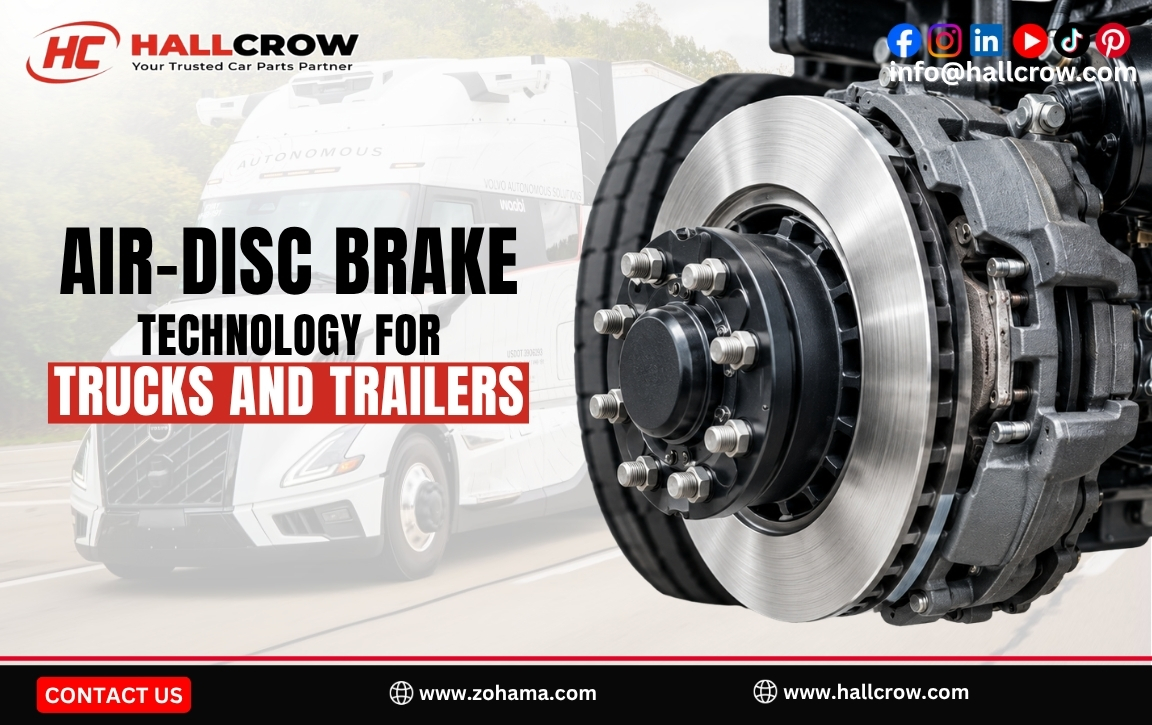
An air-disc brake combines two things: the disc (rotor and caliper) design used on most modern vehicles, and the compressed-air actuation that heavy vehicles rely on. Instead of air pushing shoes outward against a drum, air pressure drives a caliper that clamps a pair of brake pads against a flat rotor. The result is the responsiveness and heat handling of a disc brake with the power and fail-safe behaviour of a commercial air system. It is the same clamping principle as a car disc brake, scaled and actuated for the loads a truck or trailer carries.
HallCrow manufactures the air-disc pads for this system across the brake system range, so a distributor can source the friction parts the new fleets need from one manufacturer.
How It Works
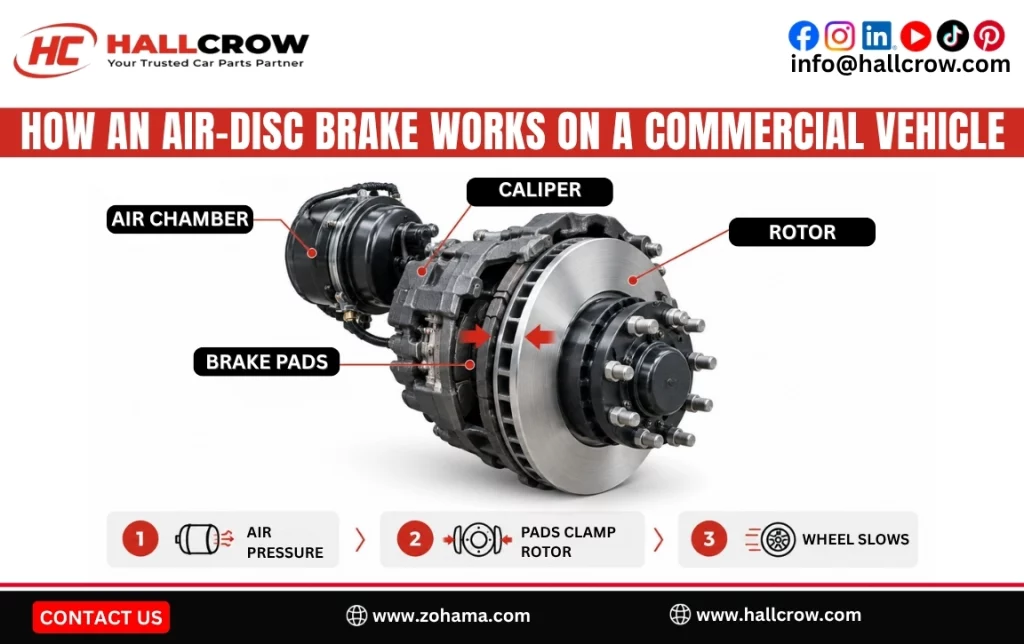
The sequence is simple and robust, which is why it suits commercial use:
- The driver applies the brake, releasing compressed air to the brake chamber at the wheel.
- The chamber drives the caliper mechanism, which clamps the two pads against the rotor.
- Friction between pads and rotor slows the wheel, and the open rotor sheds the heat quickly.
- On release, the caliper retracts and the pads clear the rotor, ready for the next application.
Why the Heavy Segment Is Moving to Air-Disc
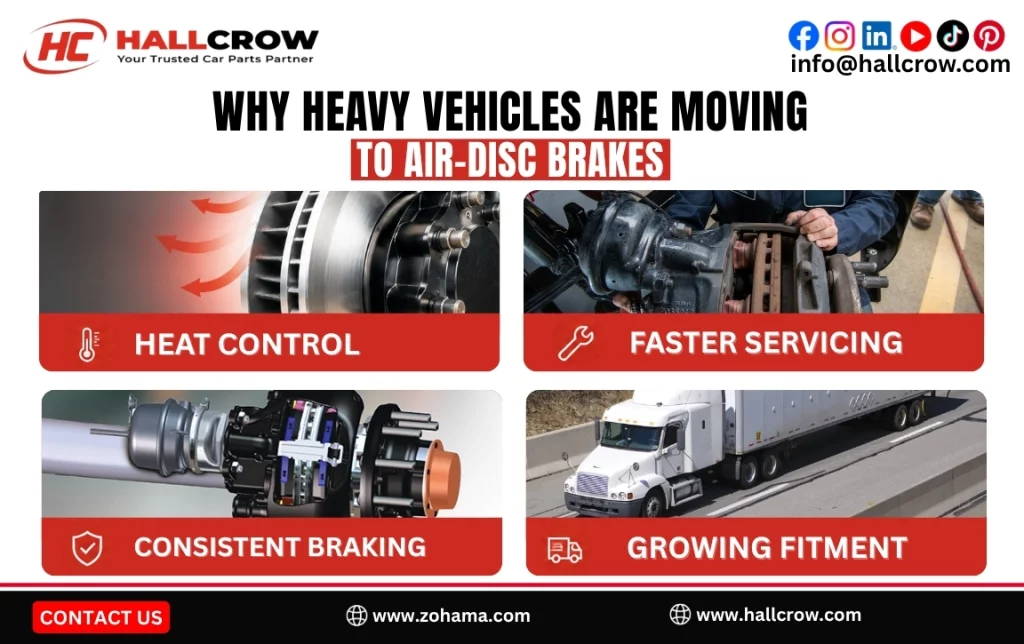
Air-disc brakes are spreading on new trucks and trailers for reasons that matter to fleets, and each one also shapes demand for the parts behind them:
| Advantage | What it means for the fleet | What it means for the parts |
|---|---|---|
| Better heat handling | Resists fade under long, loaded braking | Pads specified for high heat |
| Faster servicing | Quicker pad changes, less downtime | High pad turnover, demand for the right pad |
| More consistent braking | Easier to balance across axles | Fitment-accurate pads matter |
| Growing fitment | Standard on more new vehicles | Rising air-disc pad demand |
Air-Disc on Trailers
Trailers are a large part of the story. As prime movers move to air-disc, trailer axles increasingly follow, and major trailer-axle makers supply air-disc systems that use defined pad references. For a distributor that means air-disc demand is not limited to the truck, it extends across the trailers behind it, widening the pad demand the shift creates. Stocking air-disc pads by their reference, matched to the axle systems your market runs, captures both sides of the vehicle.
The WVA-referenced air-disc pads on the HallCrow brake pads range are built for exactly these truck and trailer axle systems.
What the Shift Means for Your Range
The practical takeaway is that air-disc is a growing share of friction demand that a distributor should stock ahead of, without abandoning the drum parts older fleets still need. Carry air-disc pads for the new prime movers and trailers, specified by reference and matched to the axle systems in your market, choose a compound built for the heat air-disc braking generates, and keep the drum consumables for the installed base that still runs them. The compound matters more on a disc under load, which is worth understanding before you weight an order.
How the friction compound affects stopping power on a loaded vehicle is covered in the brake pad material and stopping power guide.
Stock Ahead of the Shift
Air-disc is where heavy braking is going, and the distributors who stock the right air-disc pads ahead of the demand are the ones the new fleets come to. HallCrow manufactures air-disc brake pads for trucks and trailers and supplies distributors across the Middle East, Africa, Central Asia and neighbouring regions. To build an air-disc range for your market, see the products range or contact the HallCrow team.
Frequently Asked Questions
What is an air-disc brake?
It combines a disc brake (rotor and caliper clamping two pads) with compressed-air actuation. Air pressure drives the caliper that clamps the pads against the rotor, giving disc performance with commercial air-system power.
Why are trucks moving to air-disc brakes?
Air-disc brakes handle heat better, resist fade under load, are faster to service and easier to balance across axles, which is why they are increasingly standard on new trucks and trailers.
Do trailers use air-disc brakes too?
Increasingly yes. As prime movers move to air-disc, trailer axles follow, so air-disc pad demand extends across both the truck and the trailers behind it.
What should a distributor stock for air-disc?
Air-disc pads specified by reference and matched to the axle systems in your market, with a compound built for the heat air-disc braking generates, while keeping drum consumables for the installed base.
Conclusion
Air-disc brake technology brings disc performance to heavy vehicles, and it is spreading across both trucks and trailers. For a distributor the shift is a growing, specifiable demand to stock ahead of. HallCrow manufactures air-disc brake pads for trucks and trailers across its served markets.